Numerical analysis of methods and algorithms used in electronic structure calculations
In the past decades, more and more applied mathematiciens got interested into analyzing the numerical methods used by chemists and physicists in electronic structure calculations. Indeed, most of the problems arising in these fields can be reformulated as nonlinear eigenproblems: applied mathematics can thus bring new insights on the convergence of numerical methods, or even improve the existing ones, and there is still a lot to do and understand!
In my first work on such algorithms, we analyzed, in a common mathematical framework, two classes of methods that are a priori different: direct minimization and self-consistent field (SCF) algorithms. This enables for instance to understand, from a mathematical point of view, the influence of small spectral gaps on the convergence of SCF algorithms. The analysis is based on a linearization of the problem that can also be used to understand the relation between residuals (that we can compute) and discretization errors (that we want but cannot be computed).
More recently, I also worked on the convergence of the discretized solutions to linear and nonlinear periodic Schrödinger equations for a specific class of analytic potentials. By introducing Hardy-like spaces, we are able to show the exponential convergence with respect to the discretization parameters.
Related works:
E. Cancès, G. Kemlin, and A. Levitt. A priori error analysis of linear and nonlinear periodic Schrodinger equations with analytic potentials. Journal of Scientific Computing, 98(1):25, 2024. doi - pdf
E. Cancès, G. Dusson, G. Kemlin, and L. Vidal. On basis set optimisation in quantum chemistry. ESAIM: ProcS, 73:107-129, 2023. doi - pdf
E. Cancès, G. Kemlin, and A. Levitt. Convergence analysis of direct minimization and self-consistent iterations. SIAM Journal on Matrix Analysis and Applications, 42(1):243-274, 2021. doi - pdf
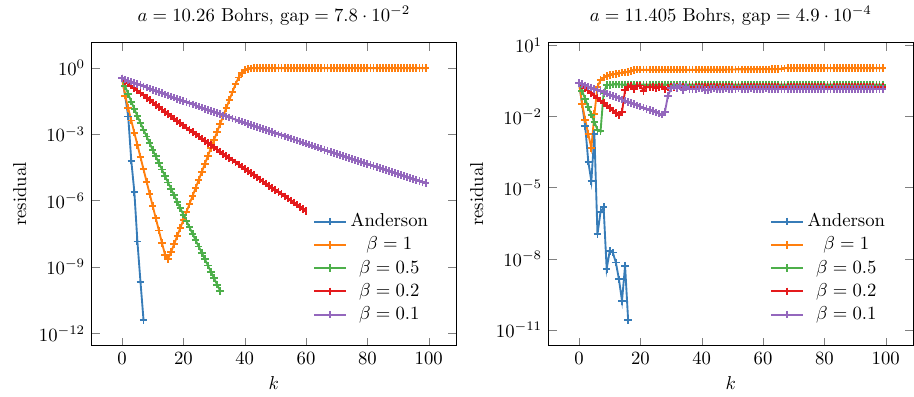 Convergence of a damped SCF algorithm for smaller and smaller spectral gaps.
CC BY-SA 4.0 Gaspard Kemlin. Last modified: June 03, 2026.
Website built with Franklin.jl, the Hyde theme and the Julia programming language.